Electric field for point charges, and using integration to find the electric field from distributions of charge
Read Tipler and Mosca (2004) chapters 21 and 22
(The electric field I and II); Pelcovits and Farkas (2024) chapter 10
(Electrostatics). For this specific exercise you may find Larson et al.
(2005) section 8.4 useful.
Electric field of a point charge
To review from last time, we saw that the electric field from a point charge is given by \[\vec{E} = \dfrac{k q}{r^2} \hat{r},\] or equivalently, \[\vec{E} = \dfrac{1}{4\pi \epsilon_0} \dfrac{q}{r^2} \hat{r}.\]
We then visualized the field for point charges and systems of point charges, and then worked problems involving point charges.
If I had a small bit of charge \(dq\), you could imagine it would make a small contribution \(d\vec{E}\) to the electric field given by \[d\vec{E} = k \dfrac{dq}{r^2} \hat{r}.\]
The resulting electric field could then be determined through
integrationThis is the third equation on your official
AP Physics C Electricity and Magentism Equation Sheet. \(\vec{E}\) is most definitely a vector, and
you must properly account for direction or components when applying
eq. 1.
: \[\vec{E} =
k \int \dfrac{dq}{r^2} \hat{r}.\qquad{(1)}\]
Let us try using this to find the field from a line charge.
Electric field of a finite line charge of charge density \(\lambda\)
Consider a line charge along the \(x\) axis stretching from \(x_1\) to \(x_2\). The charge density is given by \(\lambda\) C m−1. What is the electric field \(\vec{E}\) at a point on the \(y\) axis at \(y=Y\)?
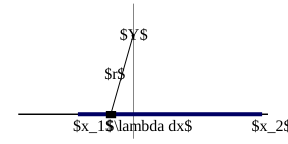
We begin by breaking the line charge into small pieces \(dx\) each containing \(dq = \lambda dx\) charge. This gives \[d\vec{E} = k \dfrac{\lambda dx}{r^2} \hat{r}.\]
At this point, it might help to break \(\vec{E}\) into horizontal and vertical components \(E_x\) and \(E_y\), respectively: \[\begin{aligned} dE_x &= -|d\vec{E}| \dfrac{x}{r} \\ dE_y &= |d\vec{E}| \dfrac{Y}{r}, \end{aligned}\] so that \[\begin{aligned} dE_x &= -k \dfrac{\lambda dx}{r^2} \dfrac{x}{r} \\ &= -k\lambda \dfrac{x dx}{r^3}, \\ \end{aligned}\] and \[\begin{aligned} dE_y &= k \dfrac{\lambda dx}{r^2} \dfrac{Y}{r} \\ &= k\lambda Y \dfrac{dx}{r^3}. \end{aligned}\]
Now we integrate. Let’s work with \(E_y\) first: \[E_y = k \lambda Y \int_{x_1}^{x_2}
\dfrac{dx}{r^3}.
\label{eq:Ey1}\] To find this integral, we will use trigonometric
substitutionLarson et al. (2005)
. We pick \(x=Y\tan{\theta}\), resulting in the
following:You could alternately pick the other angle so that
\(Y = x\tan{\theta}\), \(x=Y\cot{\theta}\), and you would eventually
get the same answer but you would have to use different limits of
integration \(\theta_1\) and \(\theta_2\) and fill in differently for
\(dx\), \(\dfrac{1}{r}\), etc.
\[\begin{aligned} x &= Y \tan{\theta} \\ \tan{\theta} &= \dfrac{x}{Y} \\ dx &= Y \sec^2{\theta} d\theta \\ Y &= r \cos{\theta} \\ \dfrac{1}{r} &= \dfrac{\cos{\theta}}{Y}. \end{aligned}\]
\[eq:Ey1\] becomes: \[\begin{aligned} E_y &= k\lambda Y \int_{\theta_1}^{\theta_2} Y \sec^2{\theta} d\theta \left(\dfrac{\cos{\theta}}{Y}\right)^3 \\ &= k\lambda Y \dfrac{1}{Y^2} \int_{\theta_1}^{\theta_2} \cos{\theta} d\theta \\ &= \dfrac{k\lambda}{Y} \int_{\theta_1}^{\theta_2} \cos{\theta} d\theta \\ &= \left. \dfrac{k\lambda}{Y} \sin{\theta} \right|_{\theta_1}^{\theta_2} \\ &= \dfrac{k\lambda}{Y} \left( \sin{\theta_2} - \sin{\theta_1} \right). \label{eq:Eyfinal} \end{aligned}\]
Do similar with \(E_x\): \[\begin{aligned} E_x &= -k\lambda \int_{x_1}^{x_2} \dfrac{x dx}{r^3} \\ &= -k\lambda \int_{\theta_1}^{\theta_2} Y \tan{\theta} Y \sec^2{\theta} d\theta \left( \dfrac{\cos{\theta}}{Y} \right)^3 \\ &= -k\lambda \dfrac{Y^2}{Y^3} \int_{\theta_1}^{\theta_2} \sin{\theta} d\theta \\ &= \left. \dfrac{k\lambda}{Y} \cos{\theta} \right|_{\theta_1}^{\theta_2} \\ &= \dfrac{k\lambda}{Y} \left( \cos{\theta_2} - \sin{\theta_1} \right). \label{eq:Exfinal} \end{aligned}\]
The resulting \(\vec{E}\) field is
then \(\vec{E} = E_x \hat{i} + E_y
\hat{j}\): \[\vec{E} =
\dfrac{k\lambda}{Y} \left( \sin{\theta_2} - \sin{\theta_1} \right)
\hat{i} +
\dfrac{k\lambda}{Y} \left( \cos{\theta_2} - \sin{\theta_1} \right)
\hat{j},\] with \(\theta_1 =
\tan^{-1}\frac{x_1}{Y}\) and \(\theta_2
= \tan^{-1}\frac{x_2}{Y}\). Not very elegant, but it worked. This is borderline
mathematical hazing. The National Anti-Hazing Hotline is a 24-hour,
toll-free number for reporting hazing incidents anonymously or with
personal information: 1-888-NOT-HAZE.
Electric field of an infinite line charge of charge density \(\lambda\)
An infinite line charge would be just like the previous case, but with \(x_1\to-\infty\) and \(x_2\to\infty\). For this case, \(\theta_1\to-\frac{\pi}{2}\) and \(\theta_2\to\frac{\pi}{2}\). Substituting into \[eq:Exfinal\] and \[eq:Eyfinal\] gives: \[\begin{aligned} E_x &= 0 \\ E_y &= \dfrac{2 k \lambda}{Y} \end{aligned}\] where \(Y\) is the perpendicular distance from the line to the point.
Rewriting this result into something with a bit more familiar form,
\[\vec{E}(r) = \dfrac{2 k \lambda}{r}
\hat{r}\]Three pages of heavy lifting with multivariate
calculus just to get this?! There must be an easier way!