Electric field
Read Tipler and Mosca (2004) chapters 21 and 22
(The electric field I and II); Pelcovits and Farkas (2024) chapter 10
(Electrostatics). See also https://www.youtube.com/watch?v=mdulzEfQXDE.
Electric field
Huh? What’s a field? What’s a vector-valued function?
An aside: gravitational field
The magnitude of the gravitational force was given by \[F = \dfrac{G M_1 M_2}{r^2}.\] It is always
attractive. Consider the case where we are a tiny mass \(m_2\) compared to a relatively ginormously
large \(M_1\) mass nearby. We might
like to get our acceleration based on being near the larger mass, and we
could get it by dividing the force by our own tiny mass. The magnitude
of this acceleration is \(g\)Our friend from AP Physics C Mechanics, \(g=\qty{9.8}{\meter\per\second\squared}\)
comes from here. \(G=\qty{6.67e-11}{\meter\cubed\per\kilo\gram\per\second\squared}\),
\(M_E=\qty{5.97e24}{\kilo\gram}\) and
\(R_E\approx\qty{6.37e6}{\meter}\);
\(g=\frac{GM_E}{R_E}\). However, the
earth is not perfectly spherical nor is it uniformly dense, leading to
local variations in \(g\) that can be
mapped with sufficiently sensitive instrumentation. \(g\) is also different on different
planets.
: \[g = \dfrac{G
M_1}{r^2},\] and the acceleration should point towards the center
of the large mass \(M_1\).
Recognizing that the acceleration \(\vec{g}\) is a vector valued function of our position, e.g. \(\vec{g}(\vec{r})\), and also noting the symmetry around a point mass in the \(\theta\) and \(\phi\) directions so that it is only dependent on \(r\): \[\vec{g}(r) = -\dfrac{G M_1}{r^2} \hat{r}.\]
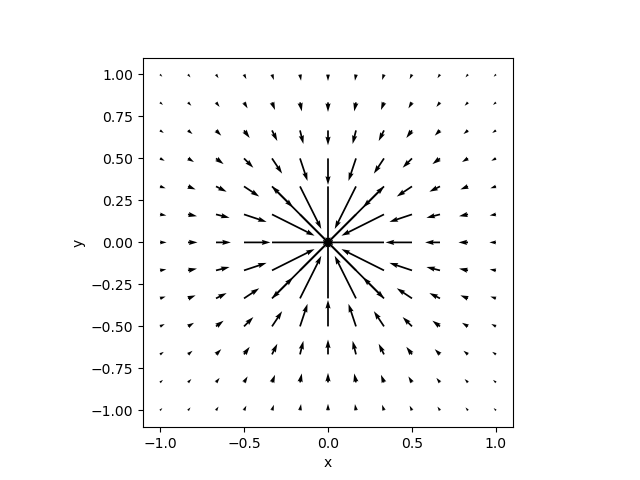
A map of this for some made up silly numbers is shown in fig. ¿fig:marginfigure?, fig. 1. We have visualized a vector field; in this case the gravitational field. The gravitational field tells us, for each point in space, where the resulting acceleration points. If we knew the mass, we could multiply it by the gravitational field to get the gravitational force.
Electric field of a point charge
By analogy with the gravitational field, we can do the same for a point charge, beginning from Coulomb’s law: \[|\vec{F_E}| = \dfrac{k q_1 q_2}{r^2}.\]
Instead of dividing force by mass to get acceleration, we divide force by charge to get the magnitude of what we will call the electric field \(\vec{E}\): \[|\vec{E}| = \dfrac{|\vec{F}_E|}{q_2} = \dfrac{k q_1}{r^2}.\]
The electric field \(\vec{E}\) is a
vector field that varies spatially. If we multiply the electric field by
a test charge (\(q_{2}\) in this case),
we get the electrostatic force acting on that test charge: \[\vec{F}_E = \vec{E} q_{2}.\] Neither eq. 1 nor eq. 2 appear on your equation sheet
for the AP Physics C E&M Exam. The closest things you have are
Coulomb’s law and the second equation on the sheet, \(\vec{E}=\frac{\vec{F}_E}{q}\). You are
expected to be able to get to the electric field from these parts if you
need it.
Returning to our original point charge, for the electric field from a positive point charge \(q\) acting on a positive test charge, we select signs and directions so that the force on the test charge will repel it in the positive \(\hat{r}\) direction: \[\vec{E} = \dfrac{k q}{r^2} \hat{r},\qquad{(1)}\] or equivalently, \[\vec{E} = \dfrac{1}{4\pi \epsilon_0} \dfrac{q}{r^2} \hat{r}.\qquad{(2)}\]
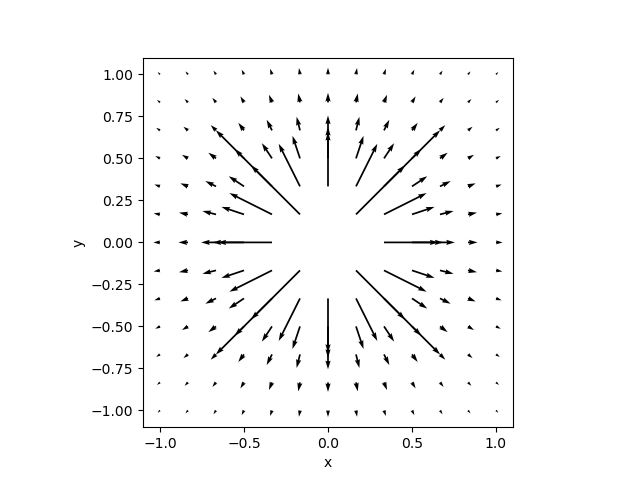
fig. 2 shows a visualization of an electric field for a point charge.
Electric field from systems of point charges using superposition
As we did with electrostatic force, we can use (linear)
superpositionfancy way to say we add things up
to find the resulting electric field from systems of
point charges, or for distributions of charge densities
by integrating \(\lambda\), \(\sigma\), or \(\rho\) over lines, areas, or volumes. For
these latter cases, there may be easier methods, as we shall see
later.
fig. 3, fig. 4 show visualizations of an electric field for two equal point charges near each other separated by a short distance.
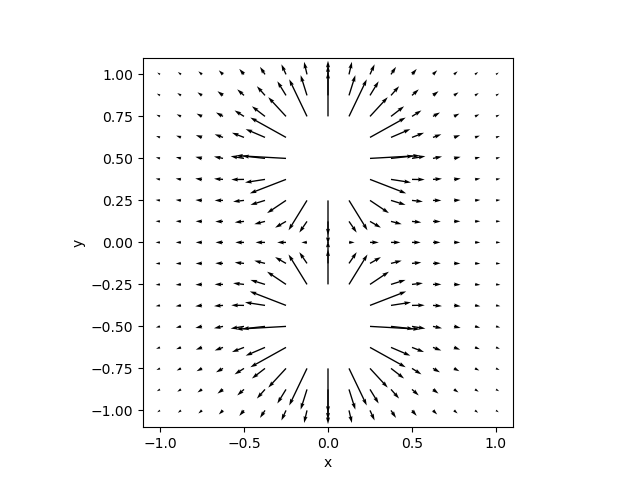
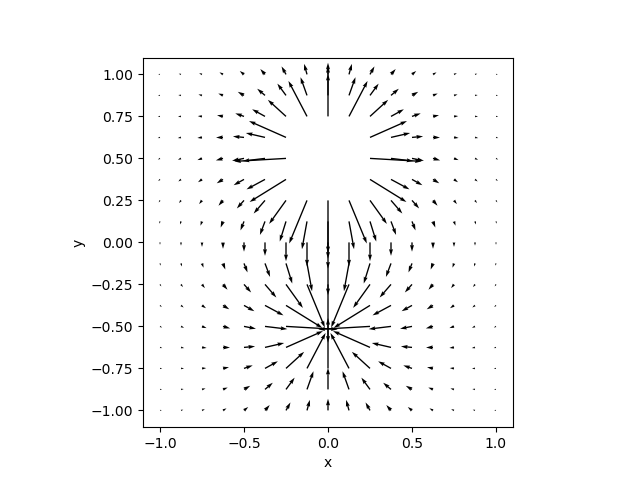
fig. 4 shows two equal but opposite point charges separated by a short distance. Field lines originate on the positive charge and end on the negative charge. Two equal and opposite charges separated a short distance in this way are called a dipole.
See also
- A nifty electric field simulation is available at PhETPhET is a collection of simulations by PhET Interactive
Simulations, University of Colorado Boulder, licensed under CC-BY-4.0
(https://phet.colorado.edu).
here: https://phet.colorado.edu/en/simulations/charges-and-fields.
Crash Course Electric Fields video, https://www.youtube.com/watch?v=mdulzEfQXDE
The Mechanical Universe, Electric Fields video, https://www.youtube.com/watch?v=wq9TjQZDrAA
MIT 8.02 Walter Lewin lecture https://www.youtube.com/watch?v=Pd9HY8iLiCA